
2023
Curso: INTERCULTURAL COLLABORATIVE CRITICAL LITERACY TEACHER EDUCATION COURSE.
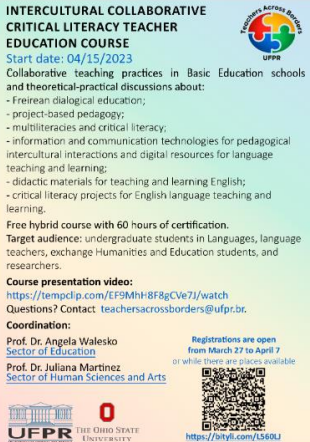
O curso, que aconteceu na modalidade híbrida, teve como objetivo promover a educação linguística dialógica por meio de trocas de saberes teórico-práticos na área de ensino-aprendizagem de línguas entre os seus 38 participantes: estudantes de graduação e de pós-graduação em Letras e Educação, professores da educação básica, local e internacionalmente, enfatizando aprendizagens locais e coletivas, com o intuito de desnaturalizar visões de mundo, expandir perspectivas e valorizar a função social e a formação da cidadania nas aulas de línguas estrangeiras ou adicionais na educação básica.
Também incentivou o mútuo crescimento intelectual, profissional e pessoal dos participantes por meio do compartilhar de conhecimentos e experiências pedagógicas que estimulassem seu interesse pela aprendizagem intercultural e interdisciplinar e impactassem positivamente suas identidades e práticas docentes individuais e, por consequência, a formação cidadã de alunos (as) e futuros alunos (as) na educação como um todo.
Período de realização: 15/04/2023 à 24/06/2023
Vídeo de
Apresentação
Objetivos alcançados
– Envolver os professores participantes do curso num processo de internacionalização localizado, dentro e fora de casa, respeitando suas capacidades e desenvolvendo suas potencialidades.
– Estudar perspectivas pós-estruturalistas de ensino e aprendizagem de Les, tais como as do letramento crítico, dos multiletramentos e da interculturalidade, bem como conhecer e implementar, de forma prática, os princípios da Pedagogia de projetos.
– Colaborativamente, elaborar e aplicar em sala materiais e atividades didáticas que contemplem tais perspectivas;
– Desconstruir estereótipos e crenças sobre o uso do inglês como uma língua franca por meio do uso dessa língua como a língua de mediação das interações interculturais promovidas no curso;
– Desenvolver a auto-confiança dos participantes para interagir na língua que aprendem e ensinam ou ensinarão, refletindo sobre sentimentos relacionados à Síndrome do Impostor, bem como sua empatia por diferentes culturas e a desmistificação do conceito de línguacultura modelo/padrão a ser usado e ensinado;
– Incentivar o senso de responsabilidade social a partir da valorização do papel do professor de línguas
estrangeiras como um
educador, agente de tansformação social por meio do diálogo e da colaboração, motivando os
participantes para a pesquisa e
para a extensão;
– Promover a comunicação afetiva, construída na alteridade, na empatia com os outros e na sensibilidade
para com as emoções
desses outros;
– Promover o desenvolvimento ou aperfeiçoamento do letramentos digitais dos participantes por meio da
utilização de recursos tecnológicos tais como plataformas virtuais, aplicativos e redes sociais para a interação intercultural, local e internacional, e desenvolvimento das atividades dos projetos de letramento crítico nas escolas;
– Oportunizar, aos licenciandos participantes, um espaço de prática de docência e interação intercultural.
Módulos do curso
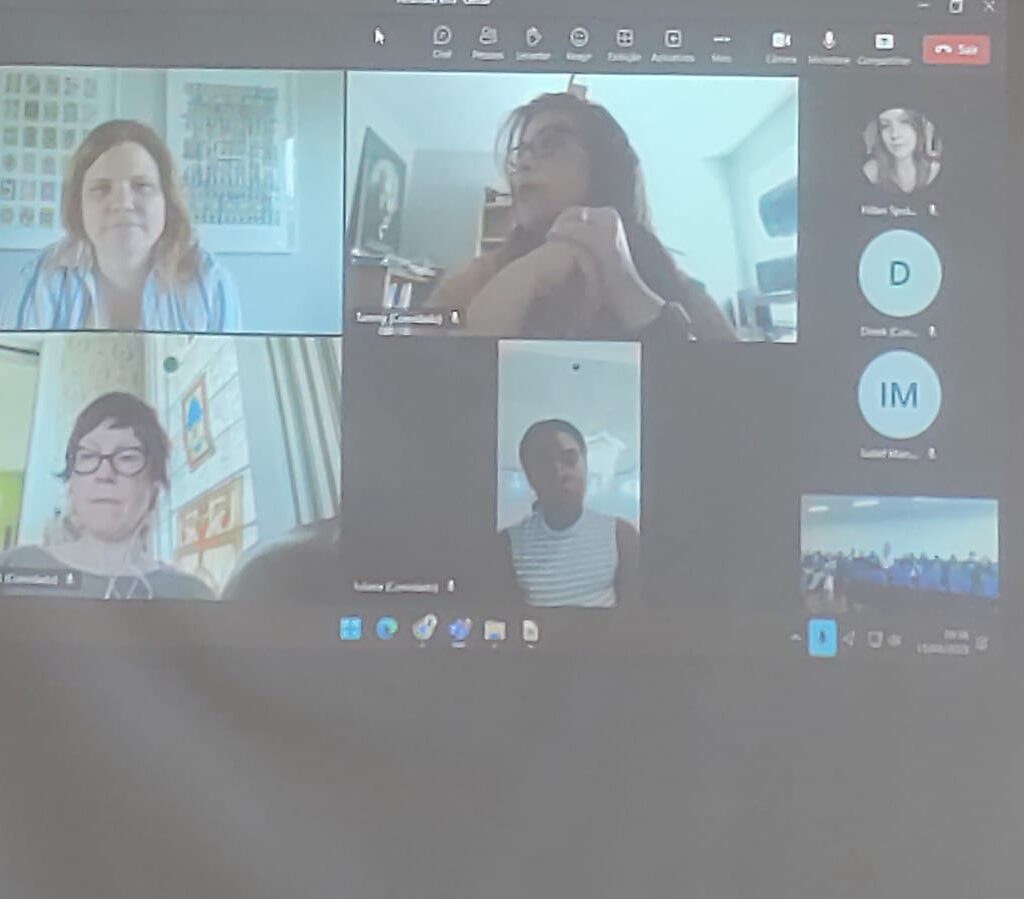
Módulo 1: TEACHING AND LEARNING EXPERIENCES INFORMED BY THE PEDAGOGY OF MULTILITERACIES/LEARNING BY DESIGN

Ministrantes convidadas: Dra. Alessandra Coutinho Fernandes – UFPR Dra. Isabel Cristina Vollet Marson – UEPG
Encontro Presencial: 15 de abril de 2023
Módulo 2: METODOLOGIA PRO PROYECTOS
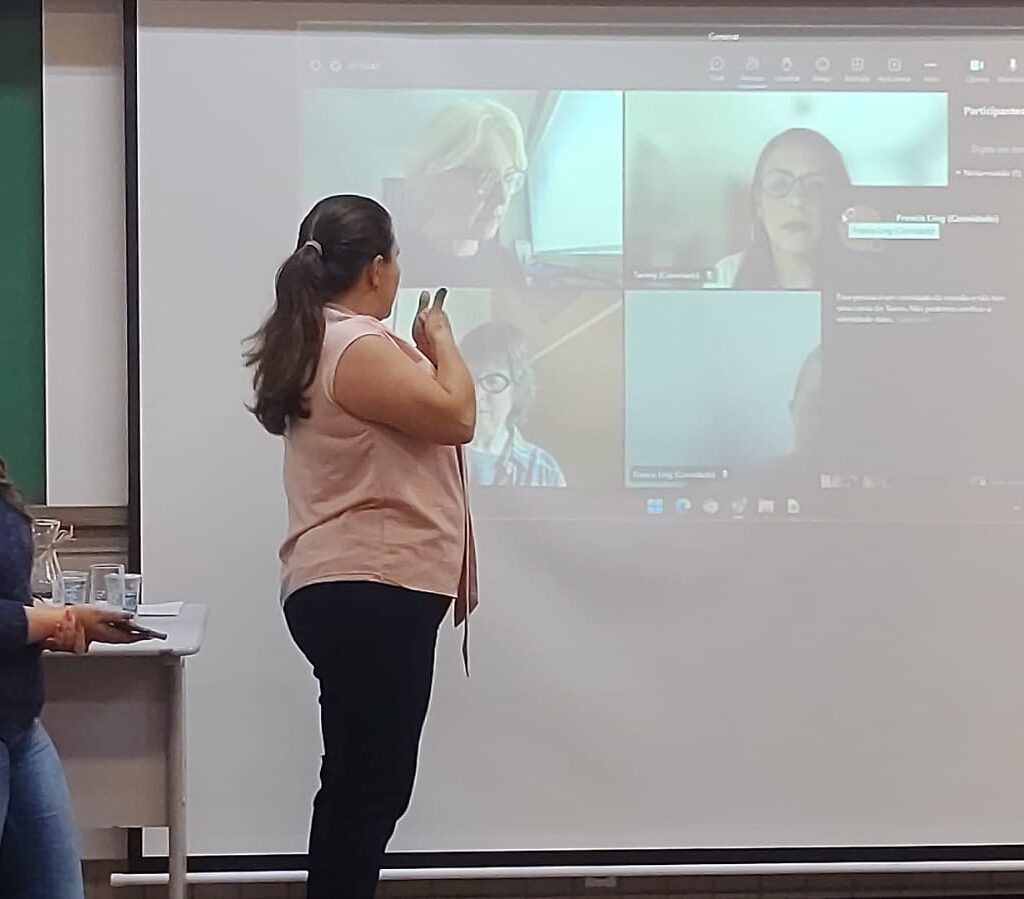
Ministrante convidada: Dra. Maristela Gabardo -IFPR
Encontro Presencial: 6 de maio de 2023
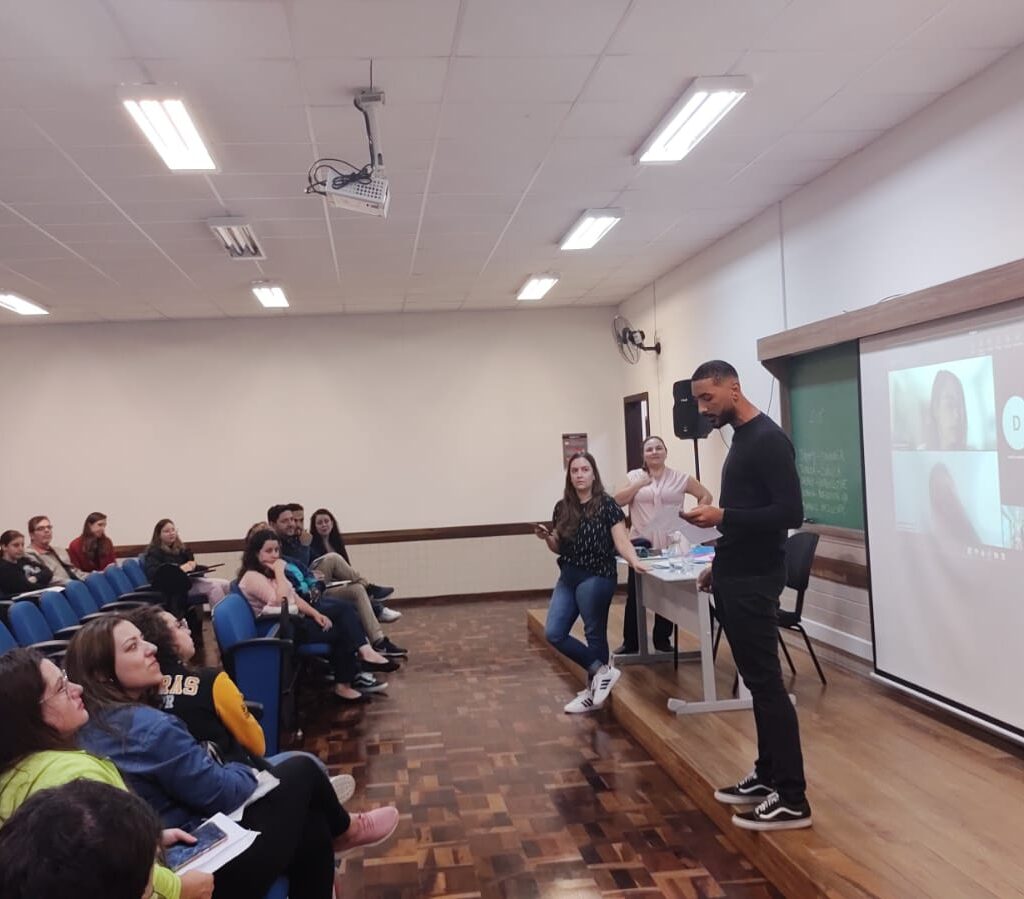
Módulo 3: Materiais didáticos para o ensino de línguas adicionais

Ministrantes convidados: Dr Rogério Tílio e Dra Deise Picanço – UFRJ
Encontro Presencial: 20 de maio de 2023
Módulo 4: Freirean Dialogical education
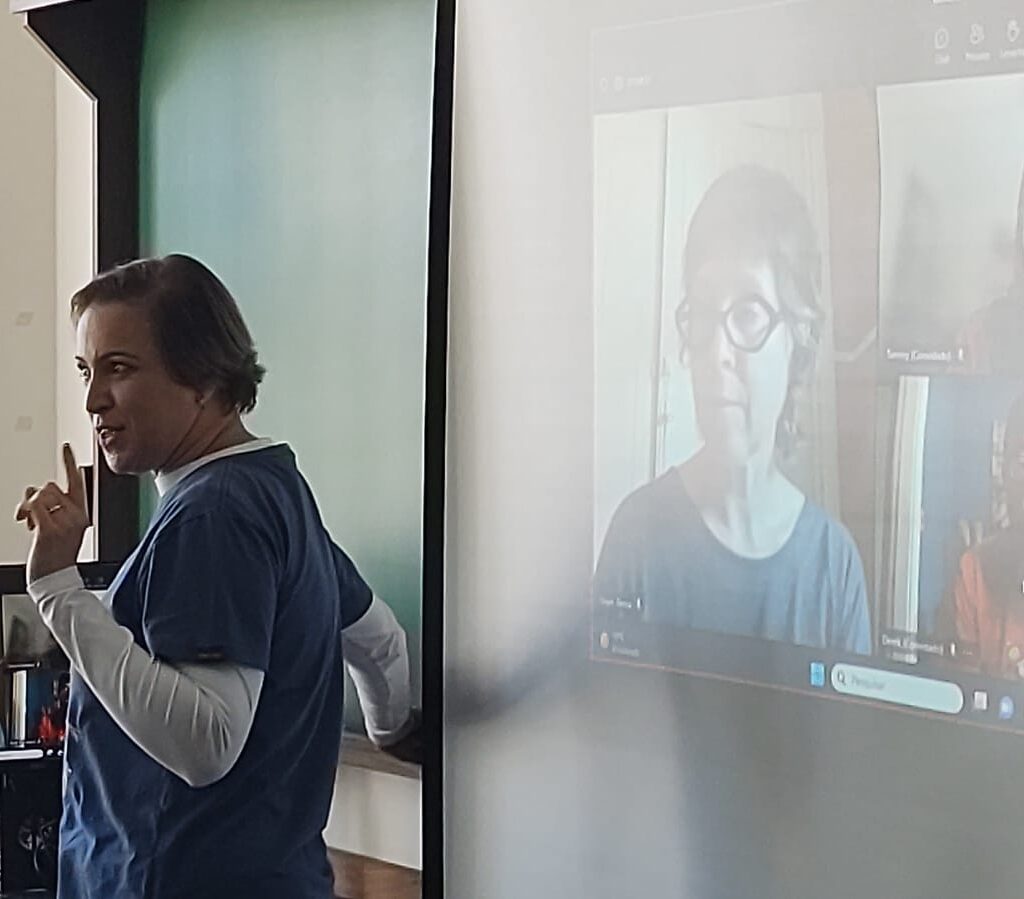
Ministrante convidada: Dra. Adriana Brahim -UFPR
Encontro Presencial: 3 de junho de 2023


Parcerias


A partir do Acordo Internacional de Cooperação, firmado em 2020 entre a Ohio State University (OSU) e UFPR, com o suporte da AIU – UFPR propusemos a parceria de trabalho entre o projeto Professores sem fronteiras: formação inicial e continuada em línguas estrangeiras e adicionais (o PsF – UFPR – ou Teachers across Borders, em inglês) ao qual este curso – Intercultural Collaborative Critical Literacy Teacher education Course está vinculado. O curso promovou a interação e intercâmbio intercultural entre brasileiros, professores da Educação Básica e licenciandos de Língua Inglesa e professores americanos, inscritos no programa IPAST da OSU (website: https://u.osu.edu/ipast/), inicialmente, online e posteriormente, quando da vinda do grupo ao Brasil em junho de 2023, presencialmente, durante as três semanas de estadia em Curitiba estudando Português na UFPR (Celin).
A parceria configurou-se como uma importante ação de internacionalização das universidades: para os professores brasileiros e para as americanas enquanto interagirem à distância, por meio de tecnologias digitais e durante sua mobilidade física em junho de 2023, quando da implementação de projetos escolares de letramento crítico, planejados com o grande grupo de participantes, à distância.
Projetos Escolares de Letramento Crítico:
Project title:
Language/s:
Responsible teachers/authors:
School/s:
Theme:
Subtheme:
Main goal: why are we doing this project?
Specific goals: what do my students need and want to learn?
Talking about the differences between Men and Women World Cup
English/Portuguese
Angela Ilivinski Krause,Valdomiro Mendes Arantes, Juliana Aparecida da Silva Barela, Derek
Colégio Estadual Professor João Loyola
Breaking Stereotypes
Woman Soccer World Cup
Talking with the students, we observe that they make preconceptions about people. They still think that there are some professions just for men and others just for women. In this way, most of them don’t know about the Women’s World Cup and how this competition is important for gender equality.
By the end of this project students will be able to…
– Understand the importance of pursuing gender equality in all media;
– critical and reflective analysis of women and their appreciation in soccer
– Know curiosities about Australia and New Zealand, countries that will host the cup
- – Learn more about US costumes & culture

Project title:
Language/s:
Responsible teachers/authors:
School/s:
Theme:
Subtheme:
Main goal: why are we doing this project?
Specific goals: what do my students need and want to learn?
Perspectivas Interculturais da Alimentação
Português e Inglês
Itamara Peters, Juliana Bráz, Leonardo Sanches, Solange de Fátima Weldt
E.M. Herley Mehl
Perspectiva intercultural da alimentação
Dialogo, Relações interculturais, Alimentação
By the end of this project students will be able to …understand about food and the language aspects involved in this social practice.
By the end of this project students will be able to…know about different cultures and habits, name their culture and food; interchange the culture.
Project title:
Language/s:
Responsible teachers/authors:
School/s:
Theme:
Subtheme:
Main goal: why are we doing this project?
Specific goals: what do my students need and want to learn?
Knowing Different Cultures through Food
ENGLISH AND PORTUGUESE
ANA KARINA ZAGO, ISABELLA DE OLIVEIRA, TAMMY JONES AND YASSIN SALAMA
COLÉGIO ESTADUAL GUARDA MIRIM DO PARANÁ
Food and culture
Menus, restaurants, ordering
By the end of this project students will be able to discuss how food can shape cultures around the world and the value of this cultural aspect.
By the end of this project students will be able to understand different words related to food and order them by reading a menu in English and besides that, be aware of the diversity of the cultures involved,focus on the American,Brazilian and Moroccan.
Project title:
Language/s:
Responsible teachers/authors:
School/s:
Theme:
Subtheme:
Main goal: why are we doing this project?
Specific goals: what do my students need and want to learn?
ASPECTOS CULTURAIS, SOCIAIS, HISTÓRICOS, POLÍTICOS, EDUCACIONAIS E ECONÔMICOS ENTRE BRASIL E ANGOLA
PORTUGUÊS
JORGE GALARCE – BRASIL, CHOCOLATE BRÁS – ANGOLA
COLÉGIO ESTADUAL PROFESSOR JÚLIO SZYMANSKI
DIREITOS HUMANOS E GLOBALIZAÇÃO
IMIGRAÇÃO
By the end of this project students will be able to …
Compreender as relações entre direitos humanos e imigração nas diferentes sociedades de fala hispânica e portuguesa.
By the end of this project students will be able to…
Compreender o funcionamento das sociedades brasileira e angolana e as relações de poder por trás dos substantivos( significado e experiência): emprego,desemprego; religião; política; respeito; educação; estado; família
Project title:
Language/s:
Responsible teachers/authors:
School/s:
Theme:
Subtheme:
Main goal: why are we doing this project?
Specific goals: what do my students need and want to learn?
Fake news: Critical Perspectives about the subject
English
Antônio Marcos Galvão, Geovanna Hayden, Renato Rudson, Francis Mara Ling e José Barbosa de Matos
Colégio Estadual Genésio Moreschi
Fake news
How to deal with hate speeches and misinformation.
In this lesson, students will share their attitudes and opinions on fake news, learn vocabulary related to fake news and digital environment and practice summarizing information in a text. Besides that, the students must be able to democratically discuss how fake news stimulates hate speeches.
– Students will think about the subject and discuss it in the great group.
– Research online new digital vocabulary and internalize it through the conversation.
– Students must be able to analyze in a critical way how information impacts real life and seek to know if it is true or false.
Project title:
Language/s:
Responsible teachers/authors:
School/s:
Theme:
Subtheme:
Main goal: why are we doing this project?
Specific goals: what do my students need and want to learn?
Impact of Lifestyle on Health and Wellness
English
Derek, Teresa, Maria Luiza de Vasconcelos Costa, Luiza Medeiros Baldança and Giselle Ferreira de Souza
Colégio Estadual Emílio de Menezes
Health and Wellness
Giving and receiving advices about healthy habits.
By the end of this project students will be able to communicate their understanding about healthy habits.
By the end of this project students will be able to identify, categorize, give and receive advice about healthy habits.
Project title:
Language/s:
Responsible teachers/authors:
School/s:
Theme:
Subtheme:
Main goal: why are we doing this project?
Specific goals: what do my students need and want to learn?
Fostering Interculturality through Multicultural Encounters
Spanish
Maristella Gabardo, Angela Maria Palacio,Thamires De Rosa Valente, Jairo Enrique Castañeda
IFPR
Intercultural encounters between Colombia and Brazil through food and football
Preparing a Latin American dinner, Music in Brazilian and Colombian football cultures
By the end of this project students will be able to recognize some Colombian cultural facts related to food and football and contrast them with Brazilian culture
By the end of this project students of the Secretary course will be able to recognize the elements of Colombian cousine and will be able to prepare and perform a dinner including the selection of the main menu, invitations and set up the event.
By the end of this project students of Mechanics 2 course will be able to recognize and compare local football aspects from Colombian-Brasil and write a stanza regarding football cheering.
Project title:
Language/s:
Responsible teachers/authors:
School/s:
Theme:
Subtheme:
Main goal: why are we doing this project?
Specific goals: what do my students need and want to learn?
Living with differences
Língua Inglesa
Profª Lídia, Daniele e Hillari
Colégio Estadual Fazenda Velha – EF EM
Respect
age, religion, sexuality, gender equality, culture.
By the end of this project students will be able to …
– Produzir um post no Canva com um dos diferentes tipos de respeito alertando a importância do tema para o convívio em sociedade.
By the end of this project students will be able to…
– Identificar os diferentes tipos de respeito existentes lendo os textos-base;
– Reconhecer as diferenças que surgem de uma atividade em comum partindo do individual para o coletivo;
Project title:
Language/s:
Responsible teachers/authors:
School/s:
Theme:
Subtheme:
Main goal: why are we doing this project?
Specific goals: what do my students need and want to learn?
Getting Emotional
English
Carolina Deconto Vieira
Colégio Estadual Leôncio Correa
Emotions
Emotional Intelligence
By the end of this project students will be able to …
– Name and better recognize their emotions
– Become more aware of their emotional intelligence
– Everyone needs to get to know themselves. This is part of our social-emotional learning.
Curso: What's Your Story?
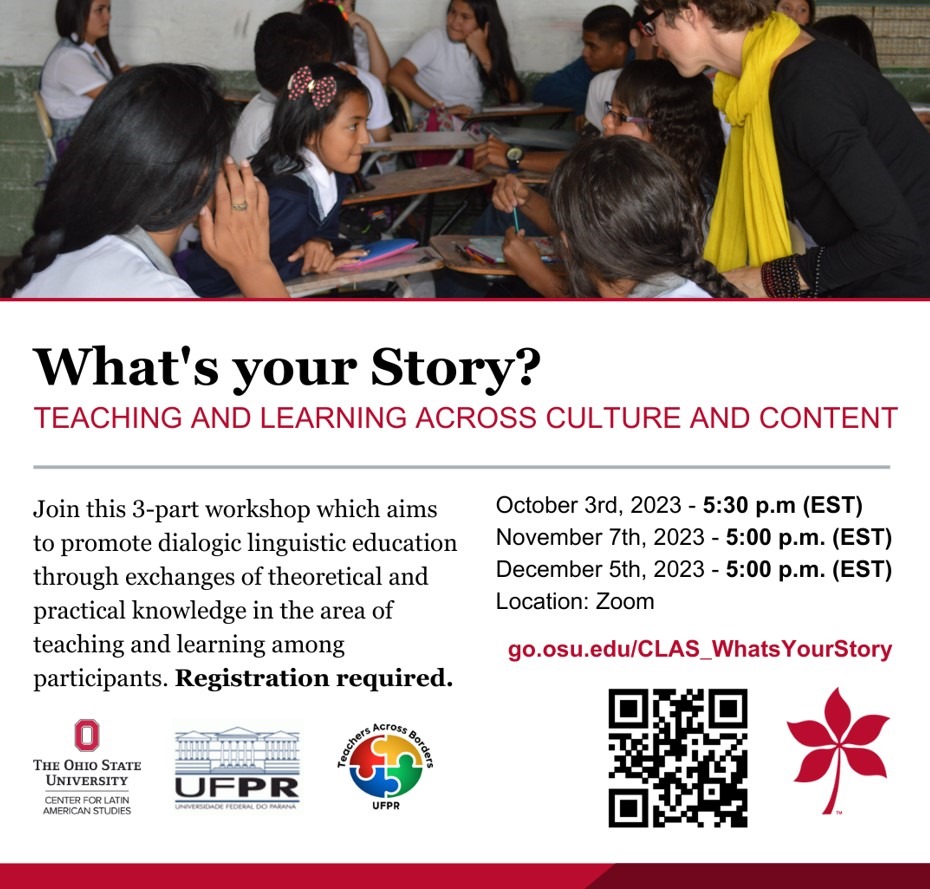
O Centro de Estudos Latino-Americanos (CLAS) da Universidade Estadual de Ohio e a Universidade Federal do Paraná Teachers across Borders (TaB-UFPR) patrocinaram recentemente uma colaboração internacional intitulada What’s your story: teaching and learning across culture and content. Este programa de três meses promoveu a educação linguística dialógica entre estudantes de graduação e pós-graduação em Línguas e Educação e professores de EL K12 no Brasil e em Ohio.
Com base nas discussões de teoria e metodologia nas duas primeiras sessões (virtuais), os participantes trabalharam juntos para desenvolver projetos escolares de letramento crítico que envolveram professores brasileiros e americanos e seus alunos em interações interculturais. As atividades dos projetos foram implementadas em novembro e início de dezembro de 2023, nas modalidades síncrona e assíncrona.
Na sessão virtual final, cinco grupos de participantes compartilharam os resultados de seu processo de ensino-aprendizagem, apresentando seus projetos e produtos e trocando uma história pessoal de uma lição aprendida. Os participantes podiam optar por obter um certificado de formação contínua de 20 horas da UFPR ou do Ohio TESOL, ou podiam optar por créditos através da Universidade de Ashland.